
Documentation Index

Fetch the complete documentation index at: https://mintlify.com/mlfoundations/open_clip/llms.txt

Use this file to discover all available pages before exploring further.

Contrastive Learning in CLIP

Contrastive learning is the training methodology that enables CLIP to learn aligned visual and semantic representations. The key insight: maximize agreement between matched image-text pairs while minimizing agreement between mismatched pairs.

Core Concept

Given a batch of N (image, text) pairs:
  1. Encode all images → N image embeddings
  2. Encode all texts → N text embeddings
  3. Compute N×N similarity matrix
  4. Train to maximize diagonal (correct pairs) and minimize off-diagonal (incorrect pairs)
Symmetric Loss: CLIP computes loss from both image→text and text→image directions, ensuring bidirectional alignment.

The Contrastive Loss Function

OpenCLIP implements the contrastive loss in src/open_clip/loss.py. The core loss is a symmetric cross-entropy loss over the similarity matrix.

Implementation

From src/open_clip/loss.py:68-155:
class ClipLoss(nn.Module):
    def forward(
            self,
            image_features,
            text_features,
            logit_scale,
            logit_bias=None,
            output_dict=False,
    ):
        device = image_features.device
        
        # Compute similarity matrix (N×N)
        logits_per_image, logits_per_text = self.get_logits(
            image_features,
            text_features,
            logit_scale,
            logit_bias=logit_bias,
        )

        # Ground truth: diagonal matrix (i-th image matches i-th text)
        labels = self.get_ground_truth(device, logits_per_image.shape[0])

        # Symmetric cross-entropy loss
        total_loss = (
            F.cross_entropy(logits_per_image, labels) +
            F.cross_entropy(logits_per_text, labels)
        ) / 2

        return {"contrastive_loss": total_loss} if output_dict else total_loss

Logits Computation

From src/open_clip/loss.py:104-130:
def get_logits(self, image_features, text_features, logit_scale, logit_bias=None):
    if self.world_size > 1:
        # Gather features from all GPUs for large batch sizes
        all_image_features, all_text_features = gather_features(
            image_features,
            text_features,
            ...
        )
        logits_per_image = logit_scale * all_image_features @ all_text_features.T
        logits_per_text = logit_scale * all_text_features @ all_image_features.T
    else:
        # Single GPU: compute scaled cosine similarity
        logits_per_image = logit_scale * image_features @ text_features.T
        logits_per_text = logit_scale * text_features @ image_features.T

    if logit_bias is not None:
        logits_per_image += logit_bias
        logits_per_text += logit_bias

    return logits_per_image, logits_per_text

Mathematical Formulation

Given normalized embeddings I (images) and T (texts):

Similarity Matrix

S = τ · I · T^T
Where:
  • τ (tau) = logit_scale.exp() - learnable temperature parameter
  • S[i,j] = scaled cosine similarity between i-th image and j-th text

Loss Function

L = 1/2 * [L_i2t + L_t2i]

L_i2t = -1/N * Σ log(exp(S[i,i]) / Σ_j exp(S[i,j]))  # Image to text
L_t2i = -1/N * Σ log(exp(S[i,i]) / Σ_j exp(S[j,i]))  # Text to image
This is equivalent to cross-entropy loss with ground truth labels on the diagonal.

Visual-Semantic Embedding Space

Contrastive learning creates a joint embedding space where:

Positive Pairs (Matching)

  • Image of “a dog playing fetch” ↔ Text “a dog playing fetch”
  • Model learns to embed these close together
  • High cosine similarity (→ 1.0)

Negative Pairs (Mismatched)

  • Image of “a dog playing fetch” ↔ Text “a cat sleeping”
  • Model learns to embed these far apart
  • Low cosine similarity (→ 0.0 or negative)

Emergent Properties

Through large-scale contrastive training:
  1. Semantic clustering - Similar concepts cluster together
  2. Cross-modal alignment - “dog” (text) aligns with dog images
  3. Compositional understanding - Model learns objects, actions, attributes
  4. Zero-shot transfer - Embeddings generalize to unseen concepts

Training Objective and Batch Construction

In-Batch Negatives

CLIP uses an efficient strategy: in-batch negatives
  • Batch size N creates N positive pairs
  • Each pair has (N-1) negative examples from other samples
  • Total comparisons: N² (N positive + N(N-1) negative)
Large batch sizes are critical for contrastive learning. More negatives = better training signal. OpenCLIP supports batch sizes up to 100K+ across distributed GPUs.

Batch Construction Example

Given batch size N=4:
Images:    [img0, img1, img2, img3]
Texts:     [txt0, txt1, txt2, txt3]

Similarity Matrix (4×4):
        txt0  txt1  txt2  txt3
img0  [HIGH   low   low   low ]  ← img0 matches txt0
img1  [ low  HIGH   low   low ]  ← img1 matches txt1
img2  [ low   low  HIGH   low ]  ← img2 matches txt2
img3  [ low   low   low  HIGH ]  ← img3 matches txt3

Goal: Maximize diagonal, minimize off-diagonal

Ground Truth Labels

From src/open_clip/loss.py:91-102:
def get_ground_truth(self, device, num_logits) -> torch.Tensor:
    # Ground truth: each image i should match text i
    labels = torch.arange(num_logits, device=device, dtype=torch.long)
    
    if self.world_size > 1 and self.local_loss:
        # Adjust labels for distributed training
        labels = labels + num_logits * self.rank
        
    return labels
Labels are simply [0, 1, 2, ..., N-1] - each sample matches its corresponding index.

Advanced Training Techniques

Local Loss

For distributed training, compute loss locally on each GPU to save memory:
if self.local_loss:
    # Only compute gradients for local image features
    logits_per_image = logit_scale * image_features @ all_text_features.T
    logits_per_text = logit_scale * text_features @ all_image_features.T
Reduces space complexity from O(n²) to effectively O(n).

Gather with Gradient

Enable gradient flow during all-gather operation:
if gather_with_grad:
    all_image_features = torch.cat(torch.distributed.nn.all_gather(image_features))
    all_text_features = torch.cat(torch.distributed.nn.all_gather(text_features))
Allows backpropagation through distributed features.

SigLIP Loss (Alternative)

OpenCLIP also implements SigLIP loss from src/open_clip/loss.py:330-464:
class SigLipLoss(nn.Module):
    """ Sigmoid Loss for Language Image Pre-Training (SigLIP) 
    Uses sigmoid instead of softmax for better scaling.
    """
    def _loss(self, image_features, text_features, logit_scale, logit_bias=None):
        logits = self.get_logits(image_features, text_features, logit_scale, logit_bias)
        labels = self.get_ground_truth(...)
        loss = -F.logsigmoid(labels * logits).sum() / image_features.shape[0]
        return loss
Benefits:
  • Better scaling to very large batches
  • No softmax normalization overhead
  • Independent per-pair loss computation

Training Configuration

Example training with contrastive loss:
python -m open_clip_train.main \
    --train-data="/data/laion400m/{00000..41455}.tar" \
    --batch-size=256 \
    --epochs=32 \
    --model=ViT-B-32 \
    --local-loss \        # Enable local loss for memory efficiency
    --gather-with-grad    # Enable gradient gathering

Key Hyperparameters

  • Batch size: Larger = more negatives = better training (256-32K typical)
  • Learning rate: 5e-4 to 1e-3 typical for CLIP
  • Warmup: Gradual learning rate increase (2000-10000 steps)
  • Temperature (τ): Learned, initialized to ~2.66

Loss Curves

During training, monitor:
  1. Contrastive loss - Should decrease steadily
  2. Accuracy - Top-1/Top-5 on diagonal predictions
  3. Zero-shot metrics - Periodic ImageNet zero-shot evaluation
From the README:
When run on a machine with 8 GPUs the command should produce the following training curve for Conceptual Captions
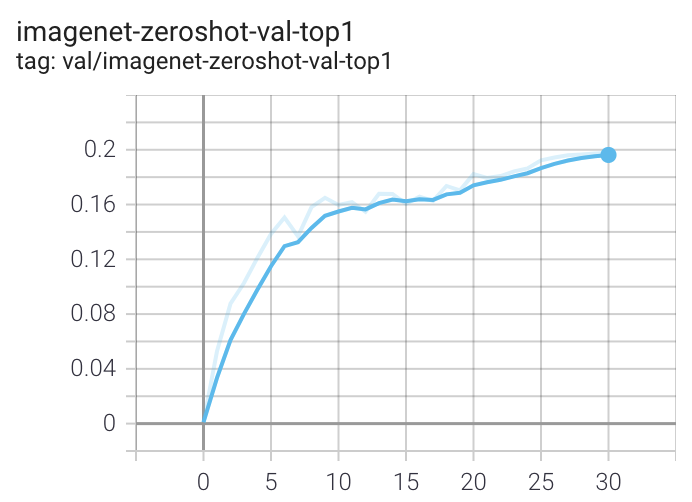
CLIP Zero-Shot Training Curve

Reference Implementation

Key files:
  • src/open_clip/loss.py - ClipLoss, SigLipLoss, CoCaLoss implementations
  • src/open_clip/model.py:265-480 - CLIP model with forward pass
  • src/open_clip_train/train.py - Training loop

CLIP Overview

High-level architecture and design principles

Zero-Shot Classification

How contrastive embeddings enable zero-shot inference

Further Reading